Biography, Parliament, the Ministry of Agriculture and Farmers Welfare, Ajmer, and the documentary archive — arranged as sixteen pages.
Informational · non-campaign · sourced
07 Agriculture & farmers
The farm economy, on the record
A policy report in sixteen chapters: the state of Indian and Rajasthan agriculture, the Ministry's programmes, and the parliamentary data laid before the Lok Sabha by the Minister of State.
Compiled
September 2026
Scope
India · Rajasthan · Ajmer
Sources
PIB, Lok Sabha answers, ICAR, Economic Survey, Government of Rajasthan
Rule
Ministry programmes are described as the Ministry's. Only documented actions are attributed to Bhagirath Choudhary.
Chapter 01
Indian agriculture: the overview
Agriculture and allied activities account for about 18% of India's gross value added (GVA), according to a written Lok Sabha reply given by Bhagirath Choudhary on 10 March 2026. At current prices, the sector's GVA rose from ₹20,93,612 crore in 2014-15 to ₹48,77,867 crore in 2023-24 — a compound annual growth rate of 8.83% — and the Second Advance Estimate for 2025-26 puts it at ₹52,08,800 crore.
The Economic Survey 2025-26 records that the sector grew at an average of about 4.4% a year over the previous five years at constant prices, and that horticulture now contributes about a third of agricultural GVA. The most recent all-India survey of farm households (NSS 77th round, 2018-19) put the average monthly income of an agricultural household at ₹10,218.
~18%share of agriculture and allied sectors in GVA
8.83%CAGR of agricultural GVA at current prices, 2014-15 to 2023-24
₹10,218average monthly income per agricultural household, 2018-19
Rajasthan: India's largest State, and its mustard bowl
Rajasthan covers 3,42,239 square kilometres, the largest area of any Indian State. In 2022-23 its net sown area was 1,84,22,557 hectares — 53.74% of its reporting area — and 95.00 lakh hectares, or 51.57% of the net sown area, were irrigated, mostly from wells and tube-wells. Irrigation ranges from 98.83% of net sown area in Kota to 19.46% in Barmer. The State Government describes farming here as "essentially rain fed".
The State produced 252.80 lakh tonnes of foodgrains in 2022-23, with wheat (44.78%) and bajra (23.41%) the largest shares. It also grew 16.15 lakh tonnes of guar seed.
Rajasthan's share of national output, 2024-25. Source: Economic Survey 2025-26, Statistical Appendix, Table 1.18.
Farmer welfare: income support, insurance and credit
PM-KISAN, launched in February 2019, transfers ₹6,000 a year to eligible landholding farmer families in three instalments of ₹2,000. By its 21st instalment more than ₹4.09 lakh crore had been paid, according to Bhagirath Choudhary's written answer of 10 March 2026. The 23rd instalment, released on 20 June 2026, paid ₹18,895.10 crore to 9,44,34,650 beneficiaries; in Rajasthan, 65,99,142 farmers received ₹1,319.84 crore.
The Pradhan Mantri Fasal Bima Yojana (PMFBY), in place since 2016-17 and voluntary for States and farmers, paid claims of ₹85,457.35 crore nationally between 2021-22 and 2025-26. Rajasthan accounted for ₹18,189.16 crore of that.
Through the Kisan Credit Card and the Modified Interest Subvention Scheme, short-term crop loans of up to ₹3 lakh carry 7% interest, reduced to an effective 4% for prompt repayment. About 7.81 crore KCC accounts were operative in August 2026, with ₹10.39 lakh crore outstanding.
Case study · Ajmer district
Crop insurance in the constituency
A Lok Sabha answer of 21 July 2026 gave district-level PMFBY data. In Ajmer district, 65.25 lakh farmer applications were covered between 2021-22 and 2025-26, with claims of ₹762.73 crore paid. In 2025-26 alone, 2,83,026 hectares — 36% of the district's gross cropped area — were insured for 2,30,495 farmers.
LS USQ 2776 (10 Mar 2026); LS USQ 259, 367 (21 Jul 2026); LS USQ 2736 (4 Aug 2026). Official answers are linked from the parliamentary archive and sansad.in.Chapter 04
Crop production: a record estimate
The Ministry's Third Advance Estimates for 2025-26, released on 27 May 2026, put total foodgrain production at a record 376.563 million tonnes, about 18.8 million tonnes (5.3%) above the 357.73 million tonnes finally estimated for 2024-25. Rice, maize, groundnut, rapeseed and mustard, and sugarcane were each estimated at record levels.
Rice154.02 MT
Wheat120.66 MT
Nutri / coarse cereals74.47 MT
Maize55.09 MT
Oilseeds43.06 MT
Pulses27.41 MT
Shree Anna (millets)17.58 MT
Case study · Lok Sabha, 17 March 2026
Eleven years of production, laid before the House
Answering Unstarred Question 3916, asked by Smt. Satabdi Roy, Bhagirath Choudhary placed before the Lok Sabha crop-wise production and procurement data for 2014-15 to 2024-25. Five of those series:
Minimum Support Prices are announced for 22 mandated crops on the recommendation of the Commission for Agricultural Costs and Prices. Since the Union Budget 2018-19, MSPs have been fixed at no less than one-and-a-half times the all-India weighted average cost of production.
Kharif Marketing Season 2026-27, ₹ per quintal (CCEA, 13 May 2026)
Crop
MSP
Paddy (common)
2,441
Bajra
2,900
Maize
2,410
Tur (arhar)
8,450
Moong
8,780
Groundnut
7,517
Soybean
5,708
Cotton (medium staple)
8,267
Rabi Marketing Season 2026-27, ₹ per quintal (CCEA, 1 Oct 2025)
Crop
MSP
Wheat
2,585
Barley
2,150
Gram
5,875
Lentil (masur)
7,000
Rapeseed & mustard
6,200
Safflower
6,540
Procurement of wheat and rice is carried out by the Food Corporation of India and State agencies; pulses and oilseeds are bought under the Department of Agriculture and Farmers Welfare's price-support operations. The answer to USQ 3916 records paddy procurement rising from 478.21 lakh tonnes in 2014-15 to a peak of 895.66 lakh tonnes in 2020-21 and 826.27 lakh tonnes in 2024-25. Wheat procurement peaked at 433.44 lakh tonnes in 2021-22 and fell to 187.92 lakh tonnes in 2022-23, before recovering to 266.05 lakh tonnes in 2024-25.
Case study · Crops Rajasthan grows
Price-support procurement, 2024-25
The same answer lists procurement in 2024-25 of crops central to Rajasthan's farm economy: 3,43,352 tonnes of bajra, 5,00,726 tonnes of mustard and 6,38,389 tonnes of moong, along with 18,02,514 tonnes of groundnut and 19,95,157 tonnes of soybean. Cotton was not procured at MSP in 2016-17, 2021-22 or 2022-23, because market prices were above MSP.
The National Agriculture Market (e-NAM) connects regulated wholesale markets on a common electronic trading platform. By 30 June 2026 it linked 1,656 mandis in 23 States and 4 Union Territories, and 247 commodities were tradable on it. Bhagirath Choudhary answered a Lok Sabha question on the e-NAM platform on 17 March 2026.
Under a central scheme begun in 2020-21, 10,000 Farmer Producer Organisations have been formed, with more than 65 lakh shareholder farmers. The Ministry has released ₹827.81 crore as management cost support and ₹631.98 crore as equity grants to them.
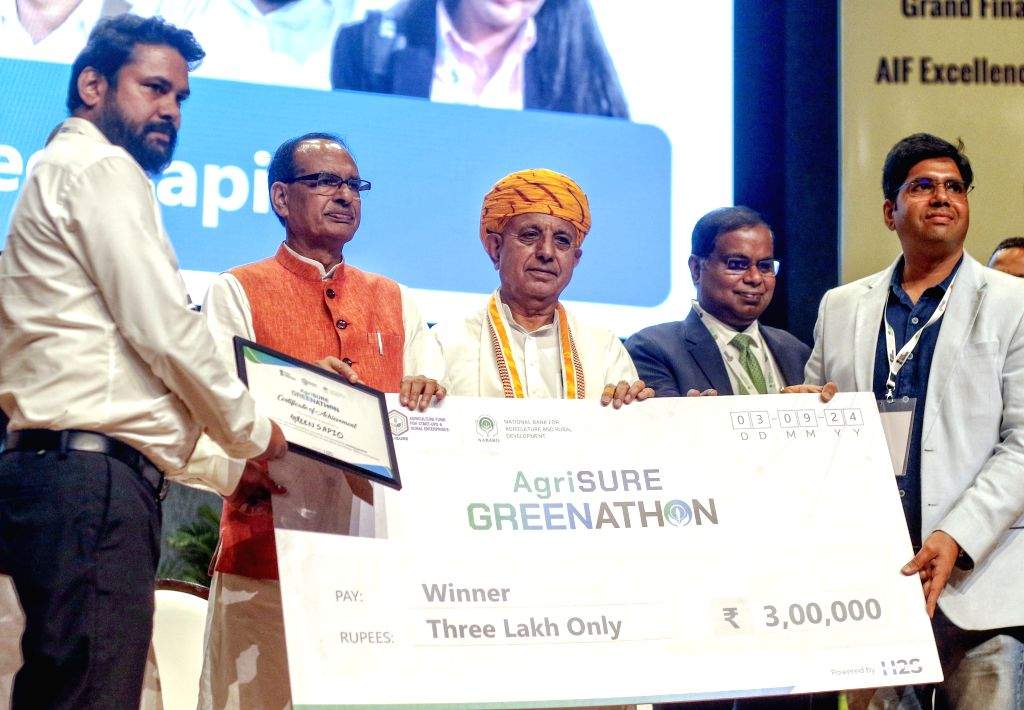
Pl. 18Launch of the ₹750 crore AgriSURE fund for agri start-ups and the Greenathon awards, presided over by Union Minister Shivraj Singh Chouhan. PIB records both Ministers of State among those present.Pusa, New Delhi · 3 September 2024LS USQ 3984 (17 Mar 2026), USQ 2600 (4 Aug 2026); PIB, 3 Sep 2024Chapter 07
Agricultural research, education and extension
The Indian Council of Agricultural Research (ICAR), founded on 16 July 1929, is the apex body of India's National Agricultural Research and Education System. It functions under the Department of Agricultural Research and Education (DARE) — the department that lists Bhagirath Choudhary as its Minister of State.
113ICAR research institutes
74agricultural universities (63 State, 3 Central, 4 deemed, 4 Central universities with agriculture faculties)
731Krishi Vigyan Kendras — 47 of them in Rajasthan
Krishi Vigyan Kendras: extension at district level
KVKs are ICAR's district-level farm science centres, following a 1976 recommendation of the National Commission on Agriculture that each district should have one. In a written answer of 4 August 2026, Bhagirath Choudhary told the Lok Sabha that KVKs had conducted 9.67 lakh frontline demonstrations and trained 62.35 lakh farmers over the previous three years, and that a 2025-26 NITI Aayog evaluation found about 91% adoption of the practices they promoted. The same answer disclosed irregularities at five KVKs — Sehore, Vidisha, Auraiya, Guntur and Thanjavur — which were withdrawn from their host organisations.
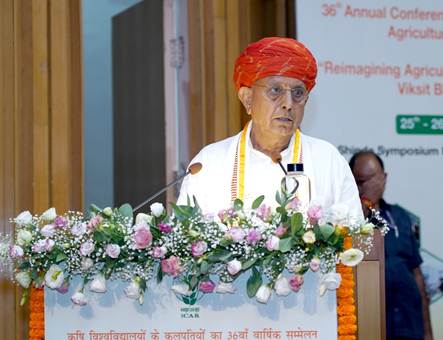
Pl. 19Addressing the inaugural session of the 36th Annual Conference of Vice-Chancellors of Agricultural Universities, themed “Reimagining Agricultural Higher Education for Viksit Bharat@2047”.New Delhi · 25 August 2026
Varieties, seed and new science
ICAR released 339 crop varieties in 2025-26 and produced 1,09,370.2 quintals of breeder seed in 2024-25. In February 2026, answering USQ 689, Bhagirath Choudhary described two genome-edited rice varieties, DRR Dhan 100 and Pusa DST Rice 1, developed with SDN-1 and SDN-2 genome editing — techniques that a Ministry of Environment, Forest and Climate Change order of 30 March 2022 exempted from the rules for genetically modified organisms.
People
Answering USQ 255 on 21 July 2026, he reported that the Agricultural Scientists Recruitment Board had initiated recruitment to 1,674 posts in 2021–2025, of which 1,256 had been filled.
ICAR's 97th Annual General MeetingAt the meeting of the ICAR Society on 18 August 2026, chaired by Union Minister Shivraj Singh Chouhan, Bhagirath Choudhary called for self-reliance in pulses, oilseeds, seeds, livestock and value-added processing, stronger Farmer Producer Organisations and market links, and a larger role for ICAR and KVKs, as reported by PIB. PIB release
The Digital Agriculture Mission, approved on 2 September 2024 with an outlay of ₹2,817 crore (central share ₹1,940 crore), is building digital public infrastructure for farming: a registry of farmers, a digital crop survey and decision-support systems. More than 10.28 crore Farmer IDs had been generated by 30 July 2026, and the rabi 2025-26 digital crop survey covered more than 31.3 crore plots in 648 districts.
The Namo Drone Didi scheme, with an outlay of ₹1,261 crore for 2023-24 to 2025-26, provides women's self-help groups with 80% assistance, up to ₹8 lakh, for agricultural drones; lead fertiliser companies distributed 1,094 drones in 2023-24.
On 16 August 2024 Bhagirath Choudhary launched the Krishi-Decision Support System, a geospatial platform, at a Ministry conference on the use of space technology in agriculture.
Crop diversification: pulses, oilseeds and millets
India imports a large part of its edible oil and some of its pulses, and two missions now target both. The National Mission on Edible Oils – Oilseeds, approved on 3 October 2024 with ₹10,103 crore for 2024-25 to 2030-31, aims to raise oilseed output from 39 million tonnes (2022-23) to 69.7 million tonnes. The Mission for Aatmanirbharta in Pulses, launched in October 2025, carries ₹11,440 crore for 2025-26 to 2030-31. Rajasthan — the country's leading producer of mustard — spent ₹74.90 crore under the oilseeds mission in 2025-26.
Millets, promoted as Shree Anna, are a Rajasthan staple: the State leads the country in nutri- and coarse-cereal production. A Lok Sabha answer by Bhagirath Choudhary on 17 March 2026 (USQ 4139) traced kodo and kutki millet output in Sidhi district, Madhya Pradesh, from 7,739.80 tonnes in 2023-24 to 10,229.76 tonnes in 2025-26.
PIB, 3 Oct 2024; LS USQ 2576 (4 Aug 2026), USQ 396 (21 Jul 2026), USQ 4139 (17 Mar 2026)Chapter 10
Irrigation
Irrigation is shared between Ministries. Large and medium projects fall under the Ministry of Jal Shakti; the Ministry of Agriculture and Farmers Welfare runs the Per Drop More Crop component of the Pradhan Mantri Krishi Sinchayee Yojana, which subsidises drip and sprinkler systems on farms. Bhagirath Choudhary answered questions on micro irrigation (USQ 2798) and Per Drop More Crop (USQ 3949) in March 2026.
In Rajasthan, only about half of the net sown area is irrigated (51.57% in 2022-23), and dependence on groundwater is heavy. As an MP, Bhagirath Choudhary sat on the Standing Committee on Water Resources from September 2019, and his first question in the Lok Sabha concerned subsidies for solar-powered irrigation.
Groundwater is the limiting resource in much of central Rajasthan. The Central Ground Water Board's report on Peesangan block of Ajmer district classified seven of the district's nine blocks as over-exploited and two as critical, with extraction in Peesangan at 207.94% of annual recharge — more than twice what is replenished. Rainfall is low and variable: the Board gives a mean annual rainfall of about 453 millimetres for the district.
The State Government's own statistics show how much the monsoon matters: in 2022-23 Rajasthan received 715.1 millimetres of rain against a normal of 575.1 millimetres.
Since 2014-15 the Soil Health Card scheme has issued 26.26 crore cards telling farmers the nutrient status of their fields, backed by a network of 8,313 soil testing laboratories. At the National Agri Input Conclave on 25 March 2025, the PHD Chamber of Commerce reported Bhagirath Choudhary urging farmers to have their soil tested and to use the help available from research centres and FPOs.
The National Mission on Natural Farming, approved by the Cabinet on 25 November 2024, promotes chemical-free cultivation through farmer clusters. By 30 July 2026 it had formed 24,031 clusters and enrolled 24,69,277 farmers on 11,81,425.73 hectares; Rajasthan accounted for 2,814 clusters and 2,66,596 farmers. The older Paramparagat Krishi Vikas Yojana supports organic farming with ₹31,500 per hectare over three years.
ICAR's National Innovations in Climate Resilient Agriculture (NICRA) programme develops and tests climate-resilient practices and varieties. Between July 2024 and March 2026, Bhagirath Choudhary answered more than fifteen Lok Sabha questions on climate change and climate-resilient crops.
LS USQ 2616 (4 Aug 2026), USQ 2962 (10 Mar 2026), USQ 2385 (6 Aug 2024), USQ 4038 (17 Mar 2026) — see the archiveChapter 14
Post-harvest systems
Losses after harvest are addressed mainly through credit for storage and processing. The Agriculture Infrastructure Fund, a ₹1 lakh crore financing facility launched on 9 August 2020, offers 3% interest subvention and credit guarantees on loans of up to ₹2 crore for warehouses, cold storage, primary processing and similar assets. In Rajasthan, ₹4,895.13 crore had been lent for 6,544 projects by July 2026. The National Horticulture Board separately gives credit-linked, back-ended capital subsidy for post-harvest management and cold-chain infrastructure.
LS USQ 3827 (11 Aug 2026), USQ 396 (21 Jul 2026), USQ 1399 (28 Jul 2026)Chapter 15
Food security
Record production and large public procurement underpin India's food-security system. Grain procured at MSP stocks the public distribution system under the National Food Security Act. Between 2014 and June 2026, total procurement came to 12,819 lakh metric tonnes, with an MSP value of ₹27.80 lakh crore; in Rabi Marketing Season 2026-27 alone, 357.57 lakh tonnes of wheat were procured from 34,82,564 farmers.
LS USQ 2560 (4 Aug 2026); LS USQ 3828 (11 Aug 2026) — answered by Minister of State Ram Nath ThakurChapter 16
Agricultural exports
India's agricultural exports reached US$ 52.55 billion in 2025-26, up 2.8% from US$ 51.12 billion in 2024-25, and up from US$ 32.08 billion in 2014-15, according to Government data released through the Press Information Bureau. Export promotion is led by the Ministry of Commerce and Industry through APEDA, not the Ministry of Agriculture.